
Retrograde calculator: check planetary motion by date
Check seven planets for a chosen UTC date. See their longitude, signed daily change and apparent direction, with the calculation method and its limits.
Compare planetary motion
All calculations run in this page using Astronomy Engine 2.1.19. No name, birth details or account is needed.
What retrograde actually describes
Retrograde motion is an apparent reversal against the background sky, caused by the changing viewing geometry as Earth and another planet move in their orbits. The planet does not stop its orbit and drive backwards. This page uses geocentric ecliptic longitude, so its direction label describes a coordinate change seen from Earth’s centre.
Read a result in three steps
First read the date: the longitude column is evaluated at 12:00 UTC. Next read the compared interval, from 00:00 UTC that day to 00:00 UTC the following day. Finally inspect the signed change. The noon position and the 24-hour direction answer different questions; a planet could turn within the interval.
Why crossing zero needs special handling
A position changing from 359.8° to 0.2° has advanced by +0.4°, not moved backwards by −359.6°. Conversely, 0.2° to 359.8° is −0.4°. The tool normalizes the difference to the shorter signed arc from −180° to +180°. The illustrated arrows are only arithmetic examples.
Increasing and decreasing longitude
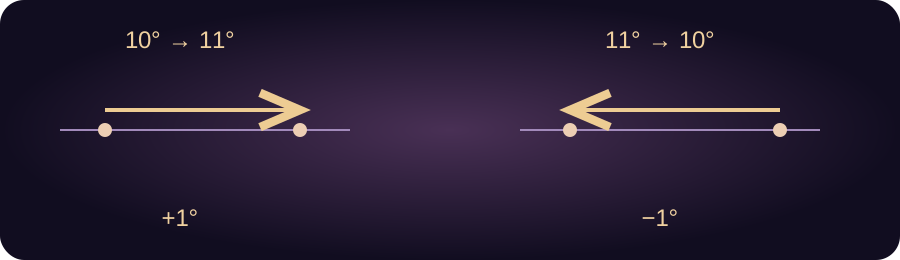
| What you see | What it means | What it does not establish |
|---|---|---|
| Positive change | Longitude increased over the displayed interval. | It does not mean a planet is closer to Earth or rising above your horizon. |
| Negative change | Longitude decreased over the displayed interval. | The planet has not physically reversed its orbit around the Sun. |
| Very small change | The absolute net change is below our 0.001° display threshold. | This is not an exact station search and does not prove zero instantaneous speed. |
Method and scope
Astronomy Engine 2.1.19 calculates geocentric vectors with aberration enabled, then converts them to true ecliptic-of-date longitudes. We compare values 12 hours before and after noon UTC. Supported dates are 1900 through 2100. This is a geocentric calculation: it does not use your location, atmospheric conditions or horizon. Displayed decimal places are not a claim of equivalent observational accuracy.
Near a station, keep the interval in mind
A station is a turning point of apparent motion. A daily difference may average motion on both sides of it. The tool calls changes smaller than 0.001° “very small”, a transparent interface threshold rather than an astronomical definition. It does not calculate station times, retrograde start/end calendars or shadow periods. Change the date to compare neighbouring days, while retaining that limitation.
Astronomical motion and symbolic interpretation
The direction calculation is geometry. Astrological interpretations are a separate cultural and symbolic practice, not established scientific evidence that a planet causes failed messages, relationship problems or a particular personality. Use ordinary checks such as confirming dates and reading agreements because they are useful, not because this table predicts an outcome.
A practical comparison exercise
Choose one planet and record its longitude and daily change on three consecutive dates. Compare whether the direction stays the same and whether the magnitude grows or shrinks. If you compare another website, match its time, time zone, geocentric convention and longitude reference first. Do not compare a day-average label with an exact station timestamp as if they were the same measurement.
Sources and calculation references
The Planetary Society · Astronomy Engine · Documentation
Why are the Sun and Moon missing?
The tool focuses on the seven other major planets viewed from Earth. It is not a complete birth chart; Earth itself is the observing reference.
Is this a list of planets retrograde right now?
It is a selected-day comparison at fixed UTC times. The today button chooses today in UTC, which can differ from your local calendar date. It is not a live instantaneous speed display.
Why does the status differ from another site near a turning point?
Different time zones, sampling intervals, thresholds or coordinate conventions can change the displayed classification. Compare exact inputs and the underlying longitudes.
Does the calculator store my date?
No. It uses the selection in the current page without an account or saved history.